
$HOOD monetizes order flow. $THOT is coming for thot flow.
thot market · $THOT · thot.market
Don’t get distilled for free.
Robinhood gets paid for routing trades. In 2025, that business generated $2.326 billion. Robinhood’s 2025 Form 10-K
Before the trade comes the thought.
You read the earnings report. Ask Claude to tear apart your thesis. Catch a mistake. Find the number everyone else missed. Buy—or decide the whole thing was a terrible idea.
Robinhood sees the order. The AI conversation contains the research that got you there.
We call that thot flow. And we think the person doing the thinking should have something to sell.
thot market lets you offer useful AI research to buyers, on terms you choose, and get paid in THOT when it sells.
Trading is the first community. The same thing happens when a programmer fixes a miserable bug, a scientist tests an idea, or an analyst works out why a company is failing. The market we want to build is for useful work, wherever it happens with AI.
The market is already forming around you
This is what the last few weeks looked like.
September 1: Mercor and SkyRL reported training a 397B model on 1,928 expert-created professional tasks. Its held-out APEX-Agents score rose from 16.11% to 27.29%. These were carefully constructed tasks with evaluation environments, not a random dump of chat history. Selecting the right work mattered.
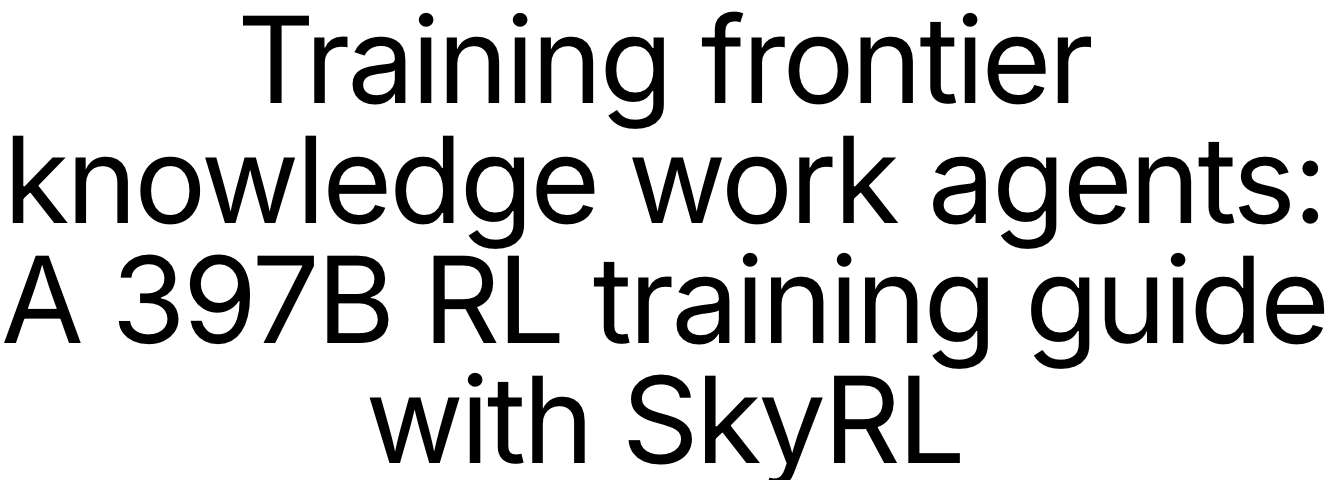
Native-resolution heading from Mercor and SkyRL’s announcement, captured September 15. The result measures an expert-task training intervention, not the value of arbitrary personal chats.
Mercor also publicly offers to pay businesses for their workflow data: messages, document edits, meeting transcripts, completed tasks. There is already a buyer-facing business around acquiring records of how people work.
September 8: Dylan Bowman raised the possibility that model distillers could gain an advantage through routers that see real user interactions. One reply got straight to the consumer proposition:
Offer discounts for queries if they can train on it.
— FoolishPig, September 8. An independent suggestion, not a statement about thot market.
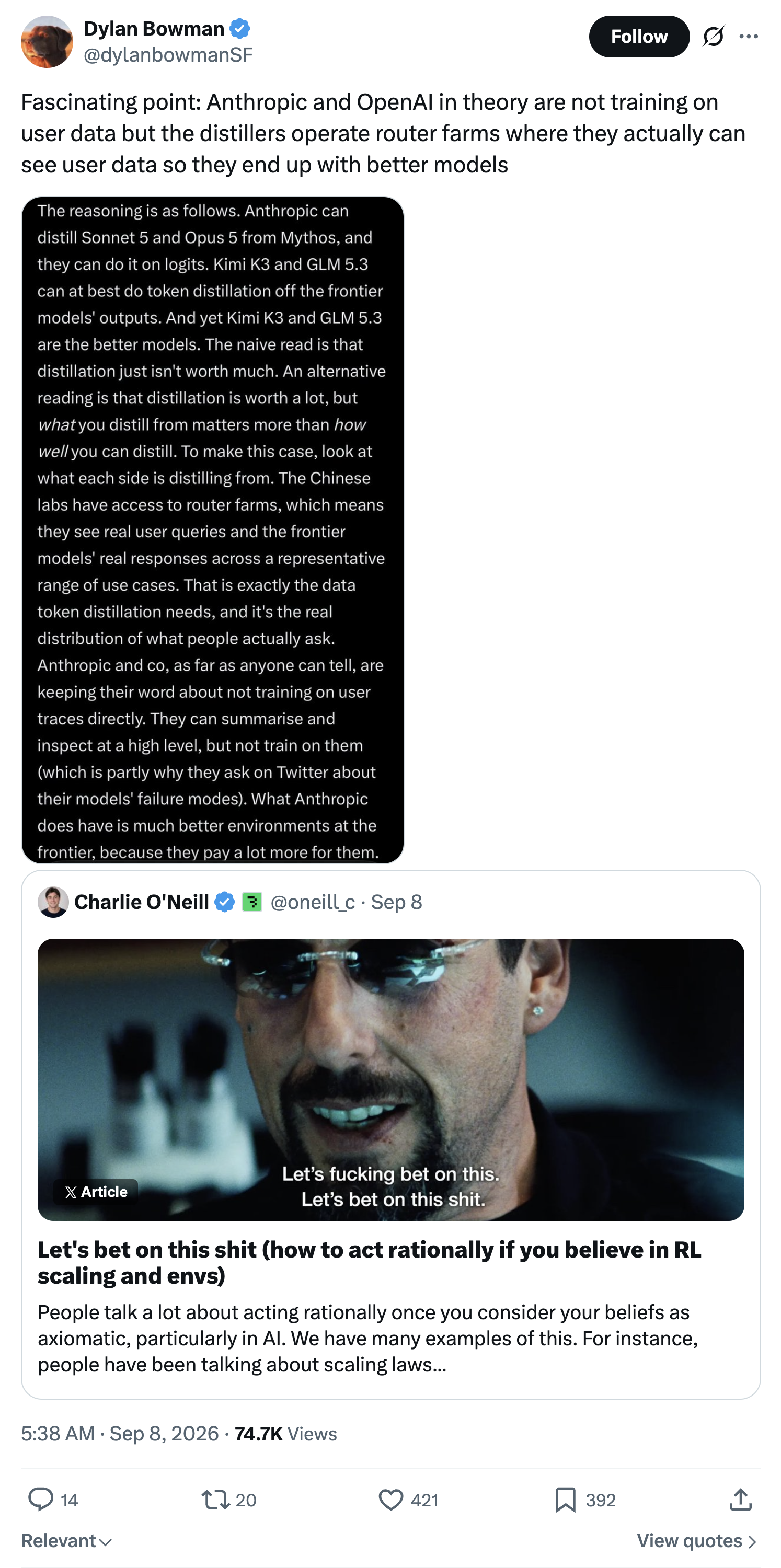
Original Dylan Bowman post, captured September 15. Tap the image for the full-resolution capture.
September 9: Aidan Gomez said he had heard rumors from lab employees about training on synthetic data derived from consumer AI interactions, particularly hard professional problems. His claim about zero-data-retention arrangements was challenged in the same conversation. That exchange is evidence of the argument happening in public, not proof of the alleged practices.
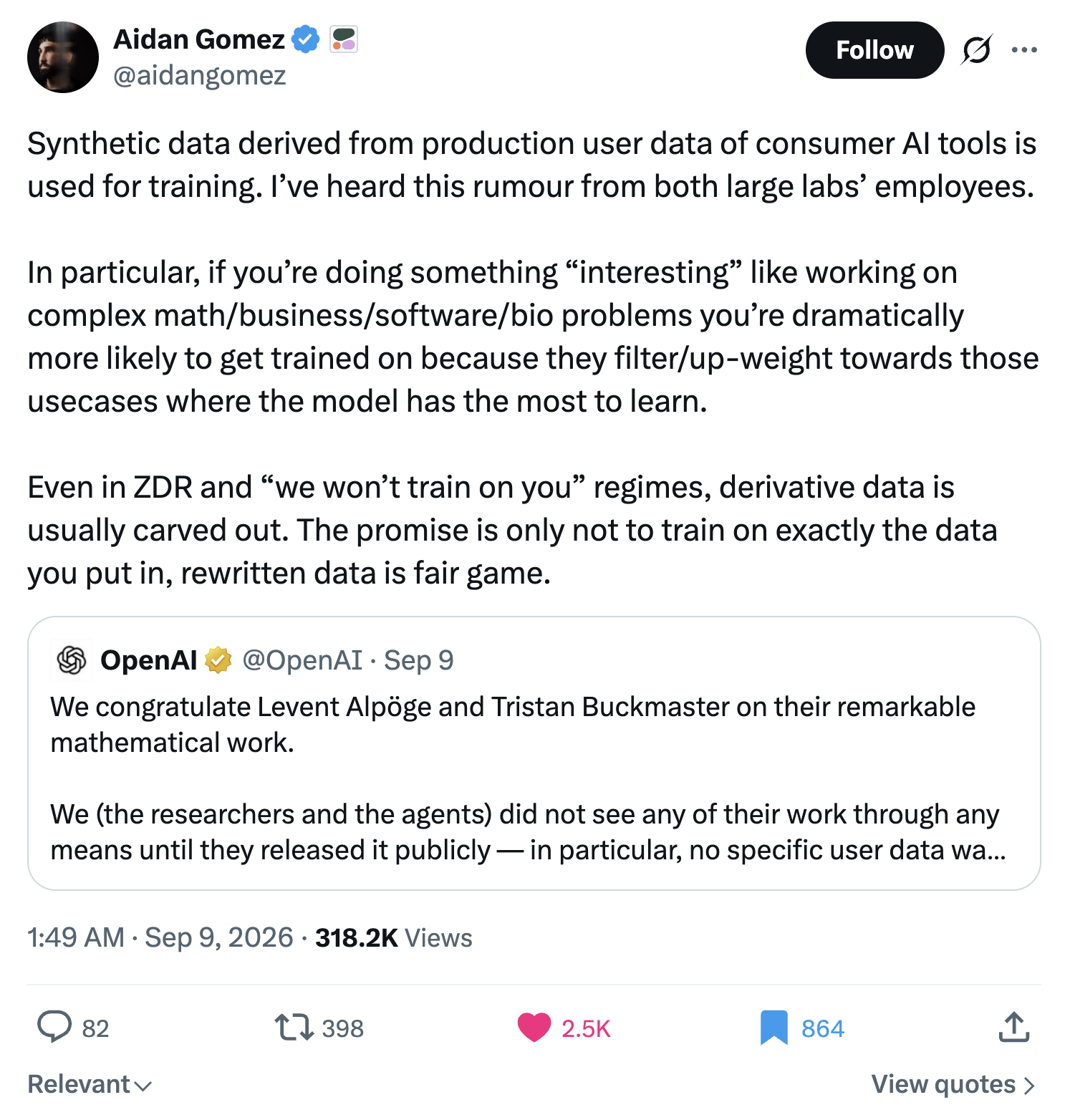
Aidan’s original post, captured September 15. Read Will Depue’s challenge alongside it.
September 11: Chaofan Shou reported buying 6TB of data from an LLM router, including exposed credentials.
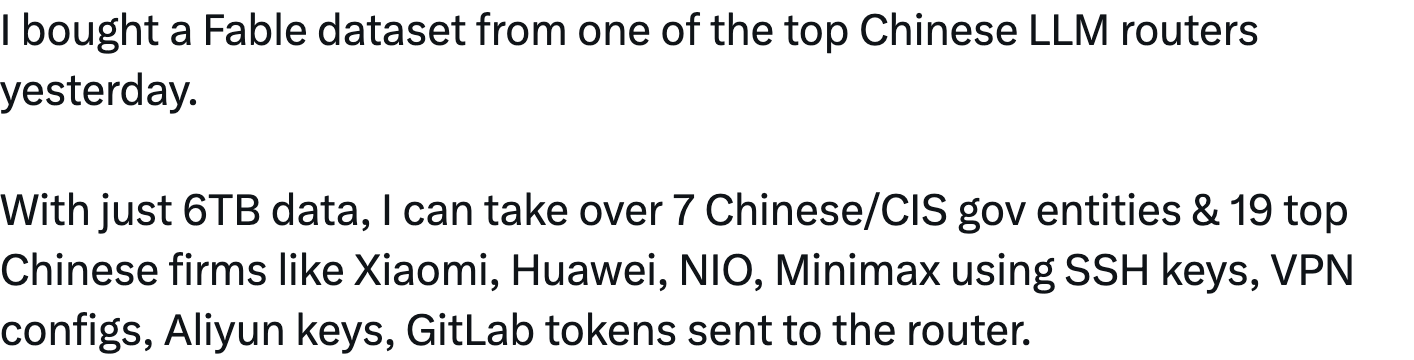
Opening excerpt of Shou’s September 11 post, captured September 15. The purchase and contents are his report; this screenshot is not independent verification of the dataset. The credential image is deliberately omitted.
The opportunity and the failure are sitting next to each other. People want the research. People also put passwords, client information and private documents into the same conversations.
A data market has to distinguish those things. It has to ask permission. And it has to pay the person who can actually license the work.
AI is compressing the useful life of your human capital
Your expertise took years to build. AI lets you apply it faster. The same process can make parts of it easier for someone else to reproduce.
The return on your expertise can rise while the time you have to earn from its scarcity gets shorter.
That is the tension behind thot market. If your research helps make expertise cheaper, you should be able to participate in the transaction.
This is more than a metaphor. A study of 5,172 customer-support agents found AI assistance increased issues resolved per hour by 15% on average, with larger gains for less experienced and lower-skilled workers. The authors discuss the tool spreading practices associated with stronger workers. That is one setting, not a forecast for every job. But it makes the economic question concrete: who captures the value when know-how becomes reproducible?
if you can’t rely on labor to generate money to make a living, capital becomes more important.
Our question is what you get to own as your work becomes data. The idea of paying people for valuable data contributions has a longer intellectual history. We want to make one narrow version practical: a market for the research you choose to contribute, with a buyer, a license and a payment receipt.
Don’t get distilled for free.
Why Robinhood Chain?
Because research and execution are getting closer together.
On August 25, Robinhood’s engineers described the architecture behind Cortex: an assistant grounded in live account data, with a history of the conversation, tool calls, tool outputs and answers. Robinhood’s July announcement of its chain and agentic trading plans also described connecting a trader’s chosen AI model to its data and tools.
The research is becoming machine-readable before the order reaches the market. Our inference is that a market for that research belongs near the people making the trades.
Robinhood monetizes order flow. thot market wants to monetize the work upstream of it.
That is the reason to start here. Coding, science and other professional work give the community more kinds of research to supply. We are making a bet about how broad this market could become, not claiming a measured TAM larger than Robinhood.
We have implemented the first narrow connection between the research and the brokerage account: a contributor can attach a hardware-attested statement that witnessed Robinhood records contained a filled trade in a named symbol within a bounded window around that trace. The statement is bound to the exact scrubbed content and licensed release. It omits the brokerage account number, quantity, price and unrelated orders.
Balance, P&L, Sharpe ratio, causal ordering, account continuity and complete-history coverage remain roadmap work. thot market is independent of Robinhood; running on its chain does not grant brokerage access or establish an endorsement.
From research trace to verified trade
Suppose a contributor records a Claude Code investigation of Ford. They can ask thot market for this property:
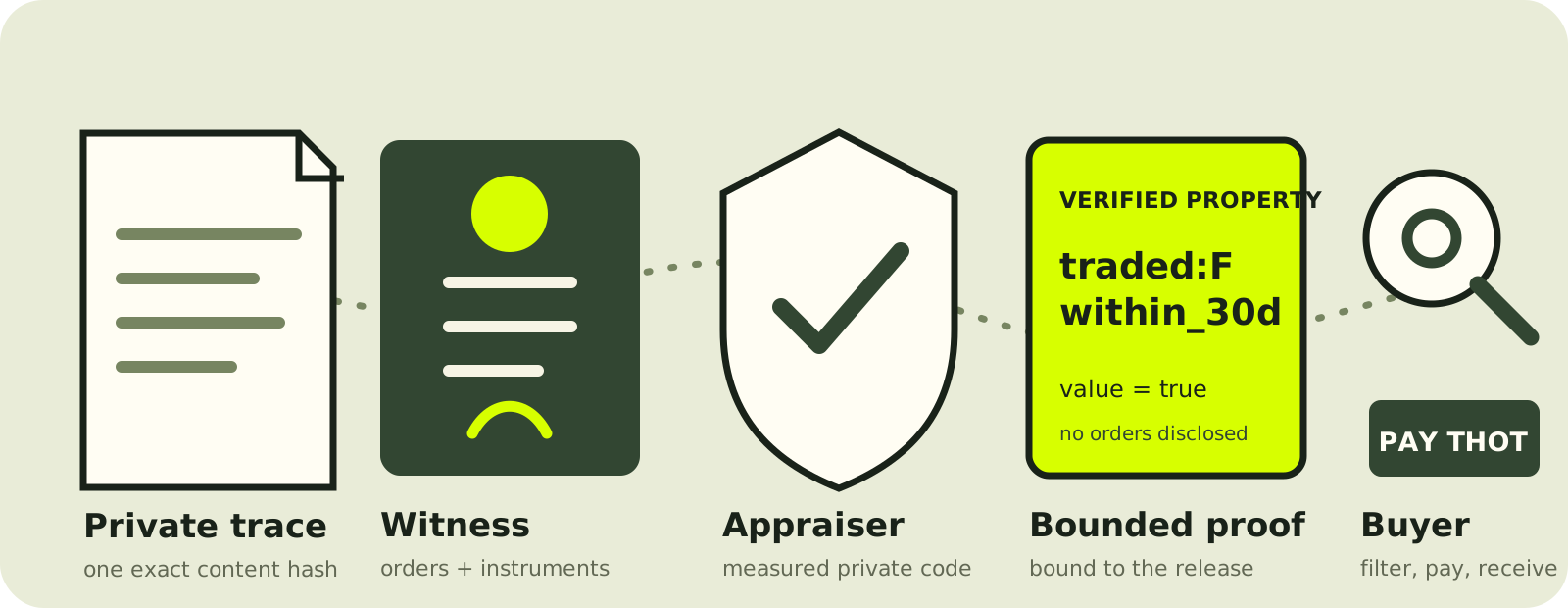
traded:F:within_30d = trueThe local helper uses their existing Robinhood browser session. A Witness records the relevant order and instrument responses. Those records are sealed to an Appraiser running in a TDX enclave. The Appraiser verifies the witnessed sessions, resolves Robinhood instrument identifiers, checks for a filled buy or sell of F, and returns only the bounded result.
The verifier checks the Appraiser’s signature, DCAP quote, measured application and operating-system identity. thot market then binds the accepted property to the scrubbed content hash and licensed release. A contributor cannot prove one release and deliver another.
The exact public claim is deliberately narrower than “this research made money”:
Witnessed Robinhood records contained a filled buy or sell of F within an absolute ±30-day window around the trace timestamp.
It does not prove that the research caused the trade, that the research came first, or that the trade was profitable. That is the point of a typed property: buyers can evaluate one fact without receiving an account statement or trusting a biography.
An ordinary buyer sees the bounded claim, public listing metadata and release commitment, but none of the research text before paying. If the claim fits the buyer’s request, they pay THOT into escrow and receive the complete scrubbed, licensed research. The marketplace checks the signed evidence and the full release commitment. The current buyer response does not include the private proof package needed to verify the Appraiser signature independently.
The current integrated acceptance test runs the real credential verifier, release binding, THOT purchase and exact delivery against signed synthetic brokerage fixtures and local Anvil. A fresh hosted Robinhood capture, approved deployed enclave identity and purchase in one release environment remain the final acceptance milestone.
Read the trade-proof tutorial for the contributor flow, private computation path, verification boundary and current limits.
What if using ChatGPT made your data balance go up?
Imagine connecting your AI history to thot market. You don’t fill out surveys or invent tasks to farm points. You keep doing the research you already do. You return tomorrow and see:
Yesterday’s conversations produced an estimated $2.40 of new trace value.
That is the experience we want to create. The example is an estimate, not a payment, and the current demo does not automatically synchronize your ChatGPT history.
A long debugging session, a carefully researched trade, and “write me a birthday message” have different value to different buyers. We want an assay that learns from what buyers want and what comparable research actually sells for.
You should be able to see what similar research has sold for before your own trace has sold. The comparison shows a gross price range, before the service tariff, and how much real evidence sits behind it. If there are too few comparable sales, it should say so. Treasury sampling prices and independent buyer prices stay separate. Neither a comparable sale nor an estimate guarantees someone will buy your trace.
You should also be able to tell, immediately, how much anyone has actually paid you.
Your research can become an asset before it becomes income. An estimate is the first step. A buyer makes it pay.
Bring your work. Keep your tools.
One useful starting point is the developer who already pays for AI, does difficult work, and cares about the bill.
The experience we want is simple: bring your own OpenRouter key, keep using your coding client, and opt in to contributing selected research. If a buyer—or the finite treasury program—acquires it, receive THOT. You still pay for inference through your existing account. The rebate is a trace-sale payment; it is not a promise that every API token earns a token back.
The September 8 reply above captures the appeal. The difficult part is deciding which work to buy, whether it is authentic, and what the contributor has agreed to release.
Participation has three steps:
- Bring your work. Import a supported history, record Codex or Claude Code sessions with the capture CLI, or connect your OpenRouter key and point an OpenAI-compatible client at the thot endpoint. Every exchange sent through the connected relay is recorded in your private vault.
- Connect once. Keep working. Set a THOT asking price and authorize the connection’s sale terms once. Completed eligible recordings are then listed automatically. Ordinary buyers see metadata and supported property results, but no excerpt. No signature is required for each conversation. Historical uploads can still be listed separately.
- A purchase pays you. A buyer funds the escrow. The authorized release is delivered, your pending proceeds appear, and an undisputed sale pays your wallet after the one-hour delivery window. Buyers pay the posted price with no membership surcharge. Your proceeds are the price less the disclosed service tariff.
Real OpenRouter JSON/SSE calls and an actual Codex subscription session have now passed hosted capture, automatic listing, purchase and exact licensed delivery. The Codex session passed through our approved TEE recorder; its receipt binds the recorded model exchange to the release. Claude Code uses the implemented connection-policy path, but a real signed-in Claude subscription run has not yet been verified. The connection setup tells you what will be recorded once; it does not interrupt every exchange. You keep paying your inference provider normally. Capturing work alone does not create a payment. Ordinary ChatGPT and Claude website histories are not automatically synchronized; the app’s connection screen identifies the available routes.
For OpenRouter research, the buyer can see which model you requested and which model OpenRouter reported returning. If the provider does not report a model, we say so. Connecting a key captures calls through the thot endpoint; it does not fetch your old OpenRouter conversations or follow calls made somewhere else. With an active connection policy, completed eligible recordings become available for purchase automatically. The default 100 THOT asking price is editable; it is a price request, not a valuation or payment guarantee.
Uploading an old conversation is useful too. It just carries a different kind of evidence from an exchange observed as it happened.
How a buyer finds something worth buying
The basic object is a funded purchase order. A buyer specifies the kind of research, the evidence it must carry, the license, the price per accepted trace and a maximum budget. For example:
Wanted: debugging research
Evidence: an accepted capture source, with sufficient provenance
Property checks: coding workflow; at least 20 recorded turns
Verified condition: witnessed filled trade in F within 30 days
License: a specific permitted use and retention period
Price: 20,000 THOT per accepted trace
Limit: 10 traces; no more than 200,000 THOT total
Illustrative order terms, not a funded offer or an API request.
The contributor authorizes the connection’s licence and price floor once. The enclave then prepares specific releases under those terms. A funded purchase proceeds automatically, without another approval. The contributor can stop future unfunded sales; purchased rights remain in force.
Before paying, an ordinary buyer gets zero trace text. They can inspect public listing metadata and supported, bounded properties attached to the release: capture source, requested and returned model identifiers when recorded, turn count, coarse workflow tags, and verified credentials such as the observed-trade property above. These results answer named questions; they do not expose the conversation or ask an evaluator to paraphrase it.
The first workflow filter uses simple keyword rules and recorded turn counts. A “coding” label is a fallible sorting hint, not a quality score. The asking price is the contributor’s; comparable-sale estimates are separate. Broader content-aware filters need a restricted assay system with a defined output schema, query budget and disclosure policy.
General buyer-supplied assayer agents require a sandbox, restricted output, limits on repeated queries and an explicit disclosure policy. That broader agent environment is a later capability. Once funded, the service makes the complete purchased release available and records delivery. That starts the one-hour dispute window; the clock does not wait for the buyer to open or download it. The rest of the contributor’s vault stays private.
A trusted execution environment can help enforce the processing boundary. Its remote attestation lets a verifier check evidence about the machine and measured software. A useful verification chain must bind the reviewed application and its keys to the particular capture or result being checked. Merely displaying a TEE hash does not prove that an uploaded conversation came from OpenAI, that its author owns a brokerage account, or that an evaluator’s price is correct.
Three different checks matter:
- Provenance: how the conversation was obtained, and what the capture actually witnessed.
- Credentials: a narrow, supported statement about its contributor, backed by a named verifier.
- Outcome: evidence that a result happened, under a defined measurement rule.
The current observed-trade property is different from a verified balance or a Sharpe ratio. A claim of strong trading performance needs a defined time window, return series and calculation, as well as authenticated source data. Those stronger financial predicates are not established by the current implementation.
The purchase receipt should bind the trace commitment, license, buyer, seller, gross price, quoted shares and settlement result. Then the contributor can distinguish an appraisal from a funded offer, and a funded offer from a completed payment.
A buyer pays THOT. You get THOT.
A buyer wants examples of how programmers fix a particular failure. Or how researchers test a thesis. Or how traders work through an earnings report.
You already chose the conversation, license and price when you contributed it. They fund a matching purchase in THOT. You do not have to come back and click Accept. The service delivers the authorized material and your pending proceeds appear.
Before handing the buyer a funding transaction, the enclave signs a short-lived review of the exact buyer, seller, release, price, current referral attribution and service tariff. The buyer's funding transaction verifies that signature onchain at the same moment THOT enters escrow; preparing and abandoning a purchase does not spend operator gas. If attribution or another reviewed input changes before funding, the transaction reverts without taking payment and the buyer must prepare a fresh quote. This checks distinct linked wallets and lets qualifying purchases enter referral and demand accounting; it does not prove different people ultimately control those wallets. Reserve demand credit requires a second decision after a purchase actually settles.
The selected settlement window is one hour after recorded delivery. The service then finalizes an undisputed purchase and sends your share to your wallet. You do not need to return to collect each sale; manual claiming remains available if the service is delayed. There is no additional lock on sale proceeds. Any existing custody lock follows its own expiry and grants no earnings advantage under the current economics. Delayed delivery, a dispute or a delayed payment worker can extend settlement. The clock starts when the purchased release is made available and delivery is recorded, even if the buyer has not opened it yet.
If delivery has not been recorded within 48 hours of the automatic sale, the buyer can recover the full payment. Once the designated operator records delivery, that timeout refund is unavailable; there is no separate objective non-delivery challenge after acknowledgment. This makes delivery acknowledgment a trust responsibility of the operator. A subjective complaint is deliberately expensive: the current reviewed, independent purchase plus prior finalized independent purchases must total at least 10 million THOT, and treasury purchases cannot use it. A first large purchase can qualify. Filing within the one-hour window freezes the seller’s proceeds. The seller has 24 hours to respond and may separately finish that period early after submitting a response. The reviewers then have seven days to decide. On this testnet, one non-conflicted owner’s vote is sufficient; nobody else can waive the seller’s response period. If the buyer wins, half of the total escrowed payment, with no membership surcharge, returns to the buyer and half is permanently sent to the canonical dead address; the seller, referrer and protocol receive nothing. If the configured reviewer threshold is not reached in time, the original sale settles. The complaint and response are stored encrypted and disclosed only to authorized case participants; their commitments, votes, deadline and monetary outcome are recorded onchain. New signed sale terms permit non-conflicted reviewers to inspect only the exact purchased release while its onchain dispute remains open and within its review period. Reads are checked and audited; unrelated vault contents stay private. Existing licences gain no new permission. This process cannot undo a copy already downloaded.
The sale terms should be concrete before you contribute. The newer economics start with the cost of operating the market, then leave the remaining price with the person whose research was bought.
Your sale price minus a disclosed service tariff. No token-balance tax.
The testnet uses a simple calibration: 0.01 TESTTHOT for direct service and 0.02 for allocated overhead. A 20% operating buffer and the referral budget produce a 0.04 TESTTHOT service fee per purchase. Sell a trace for 1 TESTTHOT and receive 0.96; sell one for 100 and receive 99.96. Those are test accounting amounts, not dollar valuations or a claim that we know the cost of every future research product.
You see the tariff before signing. The purchase freezes it. Your one-time connection authorization also protects a minimum retention floor, so a later tariff increase cannot quietly reduce your automatic-sale proceeds below what you signed.
Buying a token is not the same as financing the work
Anyone can buy licensed research by funding the THOT price. They do not need an extra membership balance, and ordinary buyers never receive a free excerpt.
Our earlier proposal rewarded idle locks with sharply better seller percentages. The newer analysis asks a better question: what does that locked capital actually pay for? If the vault cannot spend it on delivery, it provides no working-capital financing. We have removed those lock-based discounts from the testnet policy. Locking tokens alone produces no sale payment or income.
A buyer who genuinely prepays for future delivery might deserve a financing discount. That would require usable capital, a delivery schedule and explicit risk allocation. It is a separate product, not a benefit we pretend the existing lock already supplies.
Bring someone whose research matters
Introduce a contributor, with their agreement, and earn 20% of the net service contribution from qualifying purchases during their first 365 days of paid activity. They must receive their first reviewed external order within 90 days after registering the referral.
At the test calibration, a 1 TESTTHOT sale leaves the contributor 0.96. Of the 0.04 service fee, 0.01 is the fixed direct-cost allowance. A qualifying referrer receives 20% of the remaining 0.03: 0.006 TESTTHOT. The protocol receives 0.034 and remains responsible for its operating costs. The same earned contribution is not promised to several referral pools.
Register before the contributor's first sale. One contributor, one accepted direct referrer. No purchase or lock requirement for the introducer. No commission for an account signup, a forecast valuation or token trading. Treasury purchases and refunded sales produce no referral payout. Independence review excludes related-party and reimbursed activity; different wallets alone do not prove different people.
The treasury is the first buyer
Why contribute before there are buyers? Why would buyers arrive before there is useful research?
The initial answer is a finite subsidy.
We plan to buy 500 million THOT—50% of the initial supply—at creation and place it in a governed reserve with published spending restrictions. Those tokens pay for early research acquisitions through the same purchase path as everyone else. Contributors authorize a specific license and price up front, and receive THOT when a qualifying purchase settles. There is no need to mint more tokens.
The initial program can be simple: publish a sampling price, let contributors opt eligible traces into the treasury program, then buy selected research from the reserve. For every 20 new, unique, eligible traces from one opted-in contributor, the system persistently selects one complete approved release for the three authorized reserve buyers to inspect. The same selection is shown to all three; refreshing, reconnecting or using another reviewer wallet does not draw again. A contributor can sell normally while opting out of this treasury sampling and buying program.
Each reserve buyer can independently choose which selected traces to purchase. Their wallets pay gas; the reserve pays THOT directly into escrow. A 1-of-3 testnet governor controls campaign permissions, with no extra governance delay. Any one of the three owners can execute a permitted action; all purchases still fit the shared campaign ceilings. The curve opens spending allowance; it does not send money to the organizers or require them to spend it. The worker handles delivery and payout. The signers govern spending permissions; they do not hold shares of an encryption key. The enclave application checks who can read the selected release and records that access. No custom assayer agent or per-conversation seller approval is required.
Software updates are separate. The hosted test app currently uses Phala cloud KMS; migration to owner-controlled onchain upgrade governance is deferred. The whitepaper explains the remaining trust and data-migration boundaries.
Uploading the same conversation again does not create another reward. Exact import duplicates reuse your existing record. The application uses a private keyed fingerprint of the normalized source to block a second funded reserve acquisition across wallets, changed listings and differently masked copies—even after a refund. The buyer still receives the exact licensed release committed in escrow; the private duplicate fingerprint is separate. Contracts enforce purchase authority and budgets; the application enforces this duplicate check. Modified copies and multiple identities still need review.
The same disclosed service tariff applies to treasury purchases. Their retained fee returns to reserve inventory; it creates no referral reward or extra authority to spend.
The reserve is released slowly. The first campaign authorizes up to 50 million THOT in gross purchases; the other 450 million stays outside its spending authority. A declining daily limit has a 180-day half-life and a 360-day campaign term. The first 1 million THOT can seed purchases before independent buyers arrive. Further purchases are limited to at most one additional treasury THOT per THOT of reviewed independent trace spending, within the same declining limit.
These are spending ceilings. Unused daily capacity expires. Money returning from the treasury’s own purchases does not count as new demand. The exact accounting and maximum distribution are in the whitepaper.
The distinction on your screen should be clear: estimated trace value, treasury-sponsored payments, and payments from independent buyers. A treasury purchase is an actual token payment and a subsidy. We do not count it twice or call it independent customer demand.
The aim is to get a research market started, then let real buyers carry more of it as support falls.
The feedback loop
Buyers pay THOT for useful traces. Contributors receive the proceeds. Direct referrals bring in additional useful suppliers, and early reserve purchases pay for research before the market is mature. Better research gives independent buyers a reason to return.
Useful research → funded purchases → contributor earnings → more useful research.
That is the feedback loop we can implement and account for. Buyers may acquire THOT or spend existing balances. Contributors can keep their receipts or sell them. Spending treasury inventory does not create fresh outside capital.
A further proposal would give early contributors defined participation in future network surplus. It is an interesting way to recognize the market they help build. But the right, denominator, transfer rules and funded-distribution policy still need a separate design. Holding today's token is not already a cash claim on that proposal.
The loop needs research that people keep paying for. Token price appreciation is not an outcome the mechanism can promise.
Get paid while your expertise is still yours to sell
AI can raise the return on your human capital while shortening its useful life. Research that used to disappear inside an account can become something you license, earn from, and build a record around.
Later, a history of repeat purchases could give a lender a basis to advance money against future trace-sale proceeds. The lender would supply the capital and price the risk. That is a possible extension, not a borrowing facility at launch.
Today’s task is more concrete: make the useful work visible, find a buyer, and put the payment in the contributor’s hands.
Start with one sale
One useful trace. Permission to license it. A buyer who wants it. A contributor who gets paid.
Then do it again.
Robinhood monetizes order flow. We’re building thot market to monetize thot flow.
Start with the research behind a trade. Build toward a market for the useful work people do with AI.
Don’t get distilled for free.
Sources are linked at the claims they support. Social posts are attributed to their authors, and disputed claims are identified as such. The selected testnet economics and remaining production decisions are labeled above. The public app’s release status identifies which payment, capture and verification paths are enabled; a test receipt or appraisal must never be presented as a live THOT payout. thot market is independent of Robinhood.